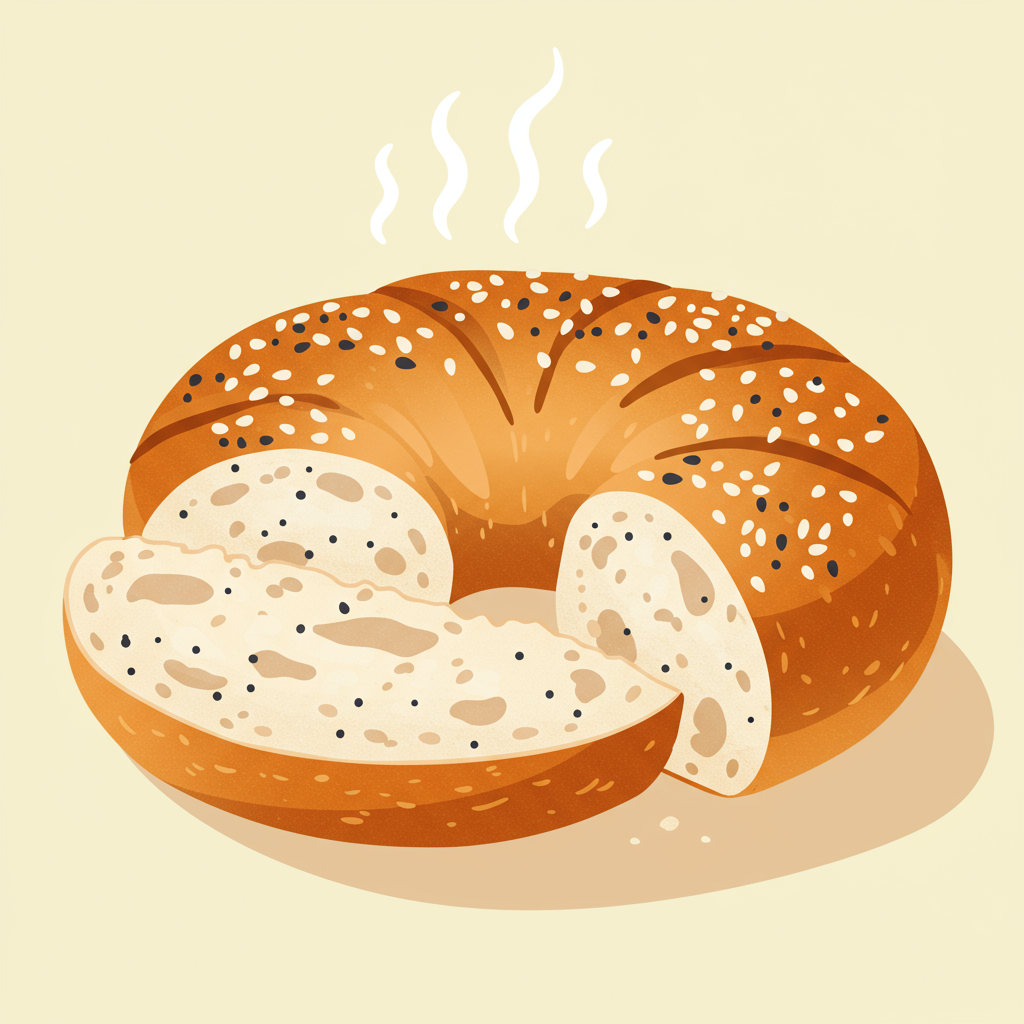
Bagel Bread Recipe: Your Ultimate Guide to Chewy, Homemade Bagels!
Are you ready to dive into the wonderful world of homemade baking? There’s truly nothing quite like the aroma of freshly baked goods filling your kitchen, and today, we’re tackling a classic that might surprise you with its simplicity: the **Bagel Bread Recipe**! Forget those trips to the bakery; with this guide, you’ll be pulling warm, chewy, and perfectly golden bagels right from your own oven. This isn’t just another one of those **easy baking recipes**; it’s an adventure in texture and flavor. We’ve packed it with all the essential **baking tips for beginners** to ensure your success. Get ready to impress yourself and your loved ones with these incredible homemade bagels!
🥯 Why You’ll Love This Easy Bagel Recipe
Many people think making bagels from scratch is a complicated endeavor, but we’re here to bust that myth! This recipe simplifies the process without compromising on that iconic bagel chew and crispy crust. We’ll walk you through each step, from activating the yeast to the crucial boiling bath, making it approachable for even the most novice baker. Imagine biting into a warm bagel, customized with your favorite toppings – pure bliss! It’s a rewarding project that builds confidence and delivers truly delicious results.
🍳 Ingredients You’ll Need
Gather your ingredients! Precision is key in baking, so make sure to measure everything accurately. This recipe yields about 12 delicious bagels.
| Ingredient | Quantity | Unit |
|---|---|---|
| Warm Water (105-115°F / 40-46°C) | 1.5 | cups |
| Active Dry Yeast | 2.25 | tsp |
| Granulated Sugar (for dough) | 2 | tbsp |
| Bread Flour (plus more for dusting) | 4.5 – 5 | cups |
| Salt | 1.5 | tsp |
| Olive Oil (or other neutral oil) | 1 | tbsp |
| For Boiling: | ||
| Water | 8 | cups |
| Baking Soda | 2 | tbsp |
| For Topping (Optional): | ||
| Egg White (lightly beaten) | 1 | large |
| Sesame Seeds, Poppy Seeds, or Everything Bagel Seasoning | 1/4 – 1/2 | cup total |
🔥 Step-by-Step Instructions: How to Make Bagels from Scratch
Let’s get baking! Follow these detailed steps to create your perfect homemade bagels.
Step 1: Activate the Yeast
In a large mixing bowl (or the bowl of a stand mixer), combine the **warm water** (ensure it’s between 105-115°F / 40-46°C – too hot will kill the yeast, too cold won’t activate it), **active dry yeast**, and **1 tablespoon of granulated sugar**. Stir gently and let it sit for about 5-10 minutes. You should see a foamy layer form on top – this means your yeast is active and ready to work its magic! If it doesn’t foam, your yeast might be old, or the water temperature was off, and you’ll need to start this step again.
Step 2: Mix the Dough
Add the remaining **1 tablespoon of granulated sugar**, **salt**, and **olive oil** to the yeast mixture. Gradually add 4 cups of **bread flour**, one cup at a time, mixing with a wooden spoon or a dough hook on a stand mixer on low speed. Once the dough starts to come together, it will be shaggy and sticky. If you’re using a stand mixer, increase the speed to medium-low. If mixing by hand, turn the dough out onto a lightly floured surface.
Step 3: Knead Your Way to Perfection
Kneading is crucial for developing the gluten that gives bagels their signature chew!
- By Hand: Knead the dough for 10-15 minutes, adding small amounts of the remaining 1/2 cup of flour as needed, until the dough is smooth, elastic, and no longer sticky. It should spring back when lightly poked.
- With a Stand Mixer: Using the dough hook attachment, knead on medium-low speed for 8-10 minutes. The dough should pull away from the sides of the bowl and be smooth and elastic.
**Beginner Tip:** Don’t be tempted to add too much flour! A slightly tacky dough is good. Over-flouring will make your bagels tough and dry.
Step 4: First Rise (Bulk Fermentation)
Lightly grease a clean large bowl with a little olive oil. Place the kneaded dough in the bowl, turning it once to coat the entire surface. Cover the bowl tightly with plastic wrap or a clean kitchen towel. Let the dough rise in a warm, draft-free place for 1 to 1.5 hours, or until it has **doubled in size**. A slightly warm oven (turned off!) is a great spot.
Step 5: Shape Your Bagels
Gently punch down the risen dough to release the air. Turn the dough out onto a lightly floured surface. Divide the dough into 12 equal pieces (you can use a kitchen scale for precision, aiming for about 3-3.5 oz or 90-100g per piece).
- Roll into Balls: Roll each piece into a tight, smooth ball.
- Create the Hole: Lightly flour your finger and poke a hole directly through the center of each dough ball.
- Stretch the Hole: Gently stretch the hole with your fingers to about 1-1.5 inches (2.5-4 cm) in diameter. The hole will shrink during boiling and baking, so make it a bit larger than you want the final hole to be.
**Common Mistake:** Don’t worry if your bagels aren’t perfectly round or uniform; homemade charm is part of the fun!
Step 6: Second Rise (Proofing)
Place the shaped bagels on a lightly floured baking sheet or parchment paper, leaving some space between them. Cover loosely with plastic wrap or a clean towel and let them rest for another 15-20 minutes. This short proofing helps them puff up slightly.
Step 7: Prepare for Boiling & Baking
While your bagels are proofing:
- **Preheat your oven** to 425°F (220°C).
- Line two baking sheets with parchment paper and lightly spray with non-stick cooking spray, or lightly dust with cornmeal.
- In a large, wide pot, bring 8 cups of water to a rolling boil. Once boiling, reduce the heat slightly to a simmer and carefully stir in the **2 tablespoons of baking soda**. This creates the alkaline environment essential for that classic shiny, chewy bagel crust.
Step 8: The Essential Bagel Boil
This step is what makes a bagel a bagel! It gelatinizes the starch on the surface, creating that signature chew and glossy finish.
- Carefully drop 2-3 bagels into the simmering baking soda water, making sure not to overcrowd the pot.
- Boil for 30 seconds to 1 minute per side. For a chewier bagel, boil closer to 1 minute per side. For a slightly softer bagel, stick to 30 seconds.
- Using a slotted spoon, carefully remove the bagels from the water, allowing excess water to drip off.
- Place the boiled bagels back onto the prepared baking sheets.
**Beginner Tip:** Be gentle when transferring the bagels. They’ll be a bit delicate after boiling.
Step 9: Top and Bake!
Once all bagels are boiled and on the baking sheets:
- If desired, brush the top of each bagel with a thin layer of **beaten egg white**. This helps toppings adhere and gives an extra shine.
- Sprinkle generously with your chosen toppings: **sesame seeds, poppy seeds, everything bagel seasoning**, or leave them plain.
- Bake in the preheated oven for 18-25 minutes, or until golden brown and cooked through. Halfway through baking (around 10-12 minutes), you might want to rotate the baking sheets for even browning.
Step 10: Cool and Enjoy
Once baked, transfer the bagels to a wire rack to cool completely. Cooling is important because it allows the internal structure of the bagel to set, preventing a gummy texture. While they’re tempting straight out of the oven, waiting just a little bit will reward you with the perfect chew. Slice them open, toast them, and slather with cream cheese, butter, or your favorite spread!
💡 Tips & Tricks for Bagel Baking Success
Here are some extra nuggets of wisdom to make your bagel-making experience even better:
- **Measure Flour Correctly:** Use the “spoon and level” method. Spoon flour into your measuring cup until it overflows, then level it off with a straight edge (like a knife). Don’t scoop directly from the bag, as this compacts the flour and results in too much.
- **The Power of Kneading:** Don’t skimp on kneading! It’s what develops the gluten, giving your bagels that characteristic chewy texture. If your arms are tired, a stand mixer is a great investment.
- **Warmth for Rising:** Yeast loves warmth. If your kitchen is cool, try turning your oven on for a minute or two, then turning it off and placing the covered dough inside to rise.
- **Don’t Fear the Boil:** The boiling step is non-negotiable for true bagels. The baking soda creates an alkaline environment that helps with browning and chewiness. Experiment with boiling times (30 seconds to 1 minute per side) to find your preferred chewiness.
- **Customize Your Toppings:** Go beyond the basics! Try dried minced garlic or onion, coarse sea salt, caraway seeds, or even a sprinkle of grated cheese in the last few minutes of baking.
- **Storage:** Store cooled bagels in an airtight container or zip-top bag at room temperature for up to 2-3 days. For longer storage, slice them, then freeze in a freezer-safe bag for up to 3 months.
- **Invest in a Scale:** For truly consistent results, a digital kitchen scale is a game-changer for measuring ingredients, especially flour and for dividing dough evenly.
🛠️ Essential Baking Tools
Having the right tools makes all the difference for a smooth baking experience:
- Mixing Bowl
- Whisk
- Baking Pan (or baking sheets)
- Measuring Cups
- Spatula (or wooden spoon)
- Large Pot (for boiling)
- Slotted Spoon or Spider Skimmer
- Parchment Paper
- Wire Cooling Rack
- (Optional) Kitchen Scale
🥯 Nutrition Information (Per Bagel)
These values are approximate and can vary based on specific ingredients and portion sizes. This estimate is for one plain bagel from this recipe.
| Nutrient | Amount |
|---|---|
| Calories | ~280 kcal |
| Carbohydrates | ~55 g |
| Protein | ~10 g |
| Fat | ~3 g |
| Fiber | ~2 g |
| Sugar | ~4 g |
❓ Frequently Asked Questions (FAQs)
Q1: What if my yeast doesn’t bubble or foam?
If your yeast doesn’t activate (bubble and foam) within 10 minutes, it’s likely dead or expired, or your water was either too hot or too cold. Unfortunately, you’ll need to discard that batch and start over with fresh yeast and carefully measured water temperature (105-115°F / 40-46°C is ideal).
Q2: Why do I have to boil the bagels before baking?
Boiling is the secret to a true bagel’s texture! The hot, alkaline water (thanks to the baking soda) sets the crust, gelatinizes the starches on the surface, and helps create that signature chewy interior and shiny, slightly crisp exterior. Without boiling, you’d just have a bread roll with a hole!
Q3: Can I make these bagels ahead of time?
Yes! After shaping the bagels (Step 5), place them on a lightly floured baking sheet, cover tightly with plastic wrap, and refrigerate overnight (up to 24 hours). The next day, remove them from the fridge about 30 minutes before you plan to boil and bake, then proceed with Step 7.
Q4: My bagels are dense or flat. What went wrong?
Several factors could cause this:
- **Under-proofing:** The dough didn’t rise enough in either the first or second proofing stage.
- **Over-proofing:** The dough rose too much, and the air bubbles collapsed during handling or boiling.
- **Not enough kneading:** Insufficient gluten development leads to a dense texture.
- **Too much flour:** This can make the dough stiff and heavy.
- **Boiling too long:** Over-boiling can make them waterlogged and dense.
Pay close attention to dough consistency and rise times.
Q5: Can I use all-purpose flour instead of bread flour?
While you *can* use all-purpose flour, bread flour is highly recommended for bagels. Bread flour has a higher protein content, which means more gluten development. This extra gluten is what gives bagels their characteristic chewy texture. Using all-purpose flour will result in a softer, less chewy bagel.
Q6: How do I store homemade bagels?
Once completely cooled, store your bagels in an airtight container or a large zip-top bag at room temperature for up to 2-3 days. For longer storage, slice them in half first, then place them in a freezer-safe bag. They can be frozen for up to 3 months. When ready to eat, toast directly from frozen.
🎉 Conclusion: Your Bagel Journey Starts Now!
You’ve made it! This **Bagel Bread Recipe** is more than just a list of instructions; it’s an invitation to experience the joy and satisfaction of baking something truly special from scratch. Don’t be intimidated by the steps; embrace the process, learn along the way, and most importantly, have fun! Your kitchen will soon be filled with the irresistible aroma of freshly baked bagels, and your taste buds will thank you. We’re confident that with these detailed instructions and **baking tips for beginners**, you’ll create bagels that are not only delicious but also a source of immense pride. So go ahead, tie on that apron, and start your bagel-making adventure today! We’d love to hear about your experience in the comments below!
“`