Welcome, aspiring bakers! Are you ready to dive into the wonderful world of homemade bread? If you’ve ever felt intimidated by bread making, today is your day to shine. We’re about to demystify the incredible Biga Bread Recipe, a method that delivers an unbelievably flavorful, airy, and crusty loaf with a surprisingly simple process. This isn’t just another one of those daunting easy baking recipes; it’s a journey into understanding the magic of fermentation, designed specifically with baking tips for beginners in mind. Forget store-bought bread – once you taste your own Biga bread, there’s no going back! Get ready to fill your home with the intoxicating aroma of freshly baked bread and impress everyone (especially yourself) with your newfound baking prowess.
Why Biga? The Secret to Superior Bread
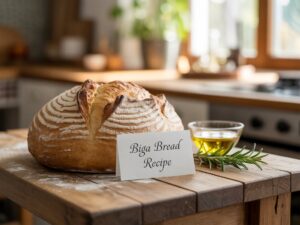
Biga is a type of pre-ferment, essentially a starter dough made from flour, water, and a tiny bit of yeast, allowed to ferment over several hours. This extended fermentation develops complex flavors and improves the dough’s structure, leading to a bread that’s not only delicious but also easier to digest. It’s the secret weapon that transforms good bread into extraordinary bread!
Ingredients for Your Biga Bread Recipe
Accuracy is key in baking, especially for beginners. Use a kitchen scale if possible for precise measurements!
For the Biga (Pre-ferment):
| Ingredient | Quantity | Unit |
|---|---|---|
| All-Purpose Flour (or Bread Flour) | 150 | grams (approx. 1 ¼ cups) |
| Cool Water | 75 | grams (approx. ⅓ cup) |
| Instant Dry Yeast | 0.5 | grams (approx. ¼ teaspoon) |
For the Main Dough:
| Ingredient | Quantity | Unit |
|---|---|---|
| All-Purpose Flour (or Bread Flour) | 350 | grams (approx. 2 ¾ cups) |
| Warm Water (95-105°F / 35-40°C) | 245 | grams (approx. 1 cup + 2 tablespoons) |
| Fine Sea Salt | 10 | grams (approx. 1 ½ teaspoons) |
| Olive Oil (optional, for flavor/crust) | 10 | grams (approx. 2 teaspoons) |
| All of the Biga |
Step-by-Step Instructions: Mastering Your Biga Bread
Follow these detailed steps carefully, and remember that baking is also about feeling the dough. Don’t be afraid to get your hands a little sticky!
Part 1: Making the Biga (Prepare 12-18 hours in advance)
- Combine Biga Ingredients: In a medium mixing bowl, add the 150 grams of flour, 75 grams of cool water, and 0.5 grams (¼ teaspoon) of instant dry yeast.
- Mix Until Just Combined: Using a spoon or your hand, mix these ingredients until a shaggy, firm dough forms. There’s no need to knead it thoroughly; just make sure all the flour is hydrated. It will be quite stiff and lumpy – this is perfectly normal for a biga! Beginner Tip: Avoid overmixing here. We’re not developing gluten yet, just getting the fermentation started.
- Cover and Ferment: Cover the bowl tightly with plastic wrap or a damp kitchen towel. Let it sit at room temperature (ideally 68-72°F / 20-22°C) for 12 to 18 hours. During this time, the biga will slowly ferment, developing a wonderful aroma and tiny bubbles. It might rise slightly and then fall, or just show some activity. How to know it’s ready: It should smell slightly alcoholic and yeasty, and have visible small bubbles on the surface and throughout when you peek inside.
Part 2: Mixing the Main Dough
- Prepare Your Ingredients: Once your biga is ready, gather all the ingredients for your main dough. Make sure your warm water is indeed warm, but not hot (test with your finger – it should feel like a warm bath).
- Combine Water and Biga: In a large mixing bowl (or the bowl of a stand mixer), add the 245 grams of warm water. Break up the fermented biga into several smaller pieces and add them to the water. Use your hands to gently squish and dissolve the biga into the water as much as possible. It doesn’t have to be perfectly smooth, but breaking it up helps distribute it evenly.
- Add Remaining Dry Ingredients: Add the 350 grams of flour and the 10 grams (1 ½ teaspoons) of salt to the bowl. If using, add the 10 grams (2 teaspoons) of olive oil now.
- Mix to Form a Shaggy Dough: Using a strong spoon, a dough whisk, or your hands, mix until all the flour is hydrated and a shaggy, sticky dough forms. This will be quite wet and messy – don’t worry! Common Mistake: Do NOT add more flour at this stage, even if it feels very wet. The dough will firm up as gluten develops.
- Autolyse (Optional but Recommended): Cover the bowl with plastic wrap and let the dough rest for 20-30 minutes. This “autolyse” step allows the flour to fully hydrate and gluten to start developing on its own, making kneading easier later.
- Knead the Dough:
- By Hand: Turn the dough out onto a lightly floured surface (and we mean LIGHTLY floured – resist the urge to add too much). Knead for 10-15 minutes. It will be very sticky at first. Use a bench scraper to help scrape it off the surface and fold it onto itself. As you knead, the dough will become smoother, more elastic, and less sticky. You’re looking for a dough that passes the “windowpane test” – you should be able to stretch a small piece thin enough to see light through it without tearing.
- By Stand Mixer: Using the dough hook attachment, knead on low speed for 2 minutes, then increase to medium-low speed and knead for 8-10 minutes. The dough should gather around the hook and pull away from the sides of the bowl.
Part 3: Bulk Fermentation (First Rise)
- First Rise: Lightly oil a clean large bowl. Transfer the kneaded dough to the bowl, turning it once to coat with oil. Cover tightly with plastic wrap or a damp towel. Let it rise in a warm spot (70-75°F / 21-24°C is ideal) for 1.5 to 2.5 hours, or until it has nearly doubled in size. Beginner Tip: The exact time depends on your room temperature. Don’t go by the clock alone; observe the dough!
- Perform Folds (Optional but Great for Structure): During the first rise, you can perform 1-2 “stretch and fold” sessions. After 45 minutes to an hour into the first rise, gently pull one edge of the dough up and fold it over the center. Rotate the bowl a quarter turn and repeat 3 more times, effectively folding all four sides. This helps strengthen the gluten. Repeat this process once more after another 45-60 minutes if desired.
Part 4: Shaping the Loaf
- Gently Degas and Pre-shape: Lightly flour your work surface. Gently turn the dough out onto the surface. Avoid aggressively punching it down. Gently pat it into a rough circle or rectangle. Pre-shape it into a round (boule) or an oval (batard) by gently folding the edges towards the center and creating tension on the surface. Let it rest, covered, for 15-20 minutes. This allows the gluten to relax, making final shaping easier.
- Final Shaping:
- For a Boule (Round Loaf): Gently flatten the dough into a rough circle. Take the top edge and fold it down to the center. Rotate the dough 180 degrees and fold the new top edge down. Now take the left and right sides and fold them into the center, overlapping slightly. Turn the dough over so the seam is down. Using cupped hands, gently drag the dough towards you on the unfloured part of the surface, rotating it slightly, to create surface tension.
- For a Batard (Oval Loaf): Gently flatten the dough into a rectangle. Take the top edge and fold it down to the center, pressing gently. Fold the top edge down again to meet the bottom edge, sealing the seam with the heel of your hand. Gently roll the dough back and forth to even out the shape and create tension.
- Prepare for Proofing: Lightly flour a proofing basket (banneton) or a bowl lined with a floured kitchen towel. Carefully transfer the shaped dough, seam-side up, into the prepared basket/bowl. Beginner Tip: The flour prevents sticking! Be generous with flouring the basket or towel.
Part 5: Final Proofing (Second Rise)
- Second Rise: Cover the proofing basket/bowl with plastic wrap or a damp towel. Let it proof at room temperature for 1 to 1.5 hours, or until it looks visibly puffy and feels light. The “Poke Test”: Gently poke the dough with a floured finger. If it springs back slowly, leaving a slight indentation, it’s ready. If it springs back immediately, it needs more time. If the indentation stays completely, it’s over-proofed (but still bakeable!).
- Cold Proof (Optional, for deeper flavor and easier handling): For even better flavor and easier scoring, you can place the covered dough in the refrigerator for 8-16 hours for a cold proof. If doing this, allow it to sit at room temperature for 30-60 minutes before baking while your oven preheats.
Part 6: Baking Your Biga Bread
- Preheat Oven and Baking Vessel: About 45-60 minutes before you plan to bake, place your Dutch oven (with its lid), baking stone, or heavy baking sheet in your oven. Preheat your oven to 475°F (245°C). It’s crucial that your oven and baking vessel are fully preheated to get a great crust.
- Prepare for Baking & Score: Once your oven is preheated and your dough is proofed, carefully remove the hot Dutch oven from the oven (use oven mitts!). Gently invert the dough from the proofing basket/bowl directly into the hot Dutch oven. If using a baking stone/sheet, gently transfer the dough onto it. Using a sharp razor blade (lame) or a very sharp knife, quickly score the top of the dough. A single deep slash (½ inch deep) or a pattern of slashes will allow the bread to expand properly.
- Bake with Steam:
- Dutch Oven Method: Place the lid back on the Dutch oven and bake for 20 minutes. The trapped steam creates an amazing crust.
- Baking Stone/Sheet Method: Immediately after placing the dough in the oven, quickly pour about 1 cup of boiling water into a metal pan on the bottom rack of your oven (be careful of the steam!). Close the oven door quickly to trap the steam. Bake for 20 minutes.
- Finish Baking:
- Dutch Oven Method: After 20 minutes, carefully remove the lid from the Dutch oven. Reduce oven temperature to 450°F (230°C). Continue baking for another 20-30 minutes, or until the crust is a deep golden brown and the internal temperature reaches 200-210°F (93-99°C).
- Baking Stone/Sheet Method: After 20 minutes, carefully remove the pan of water from the oven. Reduce oven temperature to 450°F (230°C). Continue baking for another 25-35 minutes, or until the crust is a deep golden brown and the internal temperature reaches 200-210°F (93-99°C).
- Cool Completely: Transfer the baked bread to a wire rack. This is arguably the hardest step for a beginner – you MUST let it cool completely for at least 1-2 hours before slicing! Slicing hot bread can make the interior gummy and dense. The cooling process allows the internal structure to set and steam to escape, resulting in the perfect texture.
Tips & Tricks for Beginner Bread Bakers
Baking bread is an art and a science, but these tips will set you up for success:
- Invest in a Kitchen Scale: This is the single most important tool for consistent bread baking. Measuring by weight (grams) is far more accurate than by volume (cups), especially for flour.
- Understand Your Flour: Different flours absorb water differently. If your dough feels too wet, add a tiny bit more flour (a tablespoon at a time). If it’s too stiff, add a tiny bit more water.
- Room Temperature Matters: Yeast is sensitive to temperature. Ensure your room isn’t too cold for fermentation. If it is, find a warmer spot (like inside a turned-off oven with the light on).
- Don’t Rush the Proof: Dough rises on its own schedule, not yours. Watch the dough, not the clock. Under-proofed bread is dense; over-proofed bread can collapse.
- Steam is Your Friend: The steam in the oven during the initial bake creates that beautiful, crispy crust and allows for maximum “oven spring” (the final burst of rising).
- Listen to Your Loaf: A perfectly baked loaf will sound hollow when you tap its bottom. This is a good indicator of doneness, along with internal temperature.
- Patience During Cooling: Seriously, resist the urge to cut into that beautiful, fragrant loaf immediately. Cooling lets the crumb structure stabilize and prevents a gummy interior.
- Practice Makes Perfect: Don’t be discouraged if your first loaf isn’t picture-perfect. Every bake is a learning experience. Keep notes on what worked and what didn’t.
Essential Baking Tools for Your Kitchen
Having the right tools makes all the difference. Here are some essentials (click to check them out on Amazon):
- Mixing Bowls (various sizes)
- Whisk (or a dough whisk)
- Baking Pan (if not using a Dutch oven or stone)
- Measuring Cups & Spoons (for smaller quantities, but a scale is better for flour/water)
- Spatula (or a sturdy spoon for mixing)
- Kitchen Scale: (Highly recommended, search for “kitchen scale” on Amazon)
- Bench Scraper: (Extremely helpful for handling sticky dough)
- Dutch Oven: (For the best crust and oven spring)
- Proofing Basket (Banneton): (Optional, but great for shaping and wicking away moisture)
- Sharp Razor Blade (Lame): (For scoring the dough)
Nutrition Information (Estimated per 1/12th of a loaf)
This is an estimate and can vary based on exact ingredients and loaf size.
| Nutrient | Amount |
|---|---|
| Calories | 180 kcal |
| Carbohydrates | 35g |
| Protein | 6g |
| Fat | 1g |
| Fiber | 1.5g |
| Sugar | 0g |
Frequently Asked Questions (FAQs) for Biga Bread
Q1: What exactly is biga, and why is it important?
A biga is an Italian pre-ferment, a stiff dough made from flour, water, and a very small amount of yeast, left to ferment for an extended period (usually 12-18 hours). It’s crucial because this slow fermentation develops complex flavors, aromas, and strengthens the dough’s gluten structure, leading to a bread with a more open crumb, better texture, and a crispier crust. It also improves the bread’s keeping qualities.
Q2: My biga didn’t get very bubbly. Is it still okay to use?
It depends. A biga is a relatively stiff dough, so it won’t be as bubbly as a liquid starter. You should still see some small bubbles on the surface and throughout when you examine it, and it should have a pleasant, slightly alcoholic, yeasty aroma. If it smells sour, moldy, or shows no activity at all, your yeast might have been old or the temperature too cold. If there’s some activity and a good smell, it’s likely fine to proceed.
Q3: Why is my dough so sticky and hard to handle?
Sticky dough is a common challenge for beginners! It often means the hydration is high (which is good for an open crumb), or you might be adding too much flour during kneading. Resist the urge to add excessive flour. Instead, lightly flour your hands and work surface, use a bench scraper to help manage the dough, and remember that as you knead, the gluten will develop, and the dough will become less sticky and more manageable over time. Also, ensure you allowed for the autolyse step, which helps with hydration.
Q4: How do I know when my bread is fully baked?
There are a few key indicators: the crust should be a deep golden to dark brown color (not pale!), and when you tap the bottom of the loaf, it should sound hollow. For the most accurate measure, use an instant-read thermometer to check the internal temperature. A fully baked lean bread (like this Biga bread) should register between 200-210°F (93-99°C).
Q5: Can I make the biga ahead of time and store it?
Yes, you can! After the initial 12-18 hour fermentation at room temperature, you can place your biga in the refrigerator for up to 2-3 days. This slows down the fermentation process. When you’re ready to bake, take the biga out of the fridge about 1-2 hours before you plan to mix your main dough, allowing it to come closer to room temperature and reactivate slightly.
Q6: My bread crust isn’t crispy, or my loaf didn’t rise much. What went wrong?
A lack of crispy crust usually points to insufficient steam during the initial bake or not enough heat. Make sure your oven and baking vessel are thoroughly preheated, and use the Dutch oven method or a pan of boiling water for steam. If your loaf didn’t rise much (poor oven spring), it could be due to under-proofing (not enough time for yeast activity) or over-proofing (yeast ran out of food), insufficient kneading (poor gluten development), or your oven wasn’t hot enough.
Conclusion: Your Delicious Biga Bread Awaits!
Congratulations, you’ve made it! Baking your own Biga bread is an incredibly rewarding experience, filling your home with an aroma that store-bought bread simply can’t replicate. It might seem like a lot of steps at first, but with each loaf, you’ll gain confidence and intuition. Don’t be afraid to experiment, tweak, and make this recipe your own. There’s nothing quite like pulling a warm, crusty loaf from your oven, knowing you created it with your own hands. So go ahead, bake that bread, share it with loved ones, and savor every delicious slice. Happy baking!
“`